Powder Coating vs. Liquid Paint: Which Finish Lasts Longer in South Florida?
Salt air. Ninety-degree humidity. A sun that does not take days off. If you live or run a business in South Florida, you already know what those three things do to metal — rust creeping under a gate, peeling paint on a railing, a trailer frame that looks five years older than it is. The question we hear every week at Fast Paint is simple: *should I use powder coating or liquid paint?*
The short answer: for anything that lives outdoors in Miami-Dade, powder coating almost always wins. Here is the longer answer, with the facts that actually matter.
What Is Powder Coating?
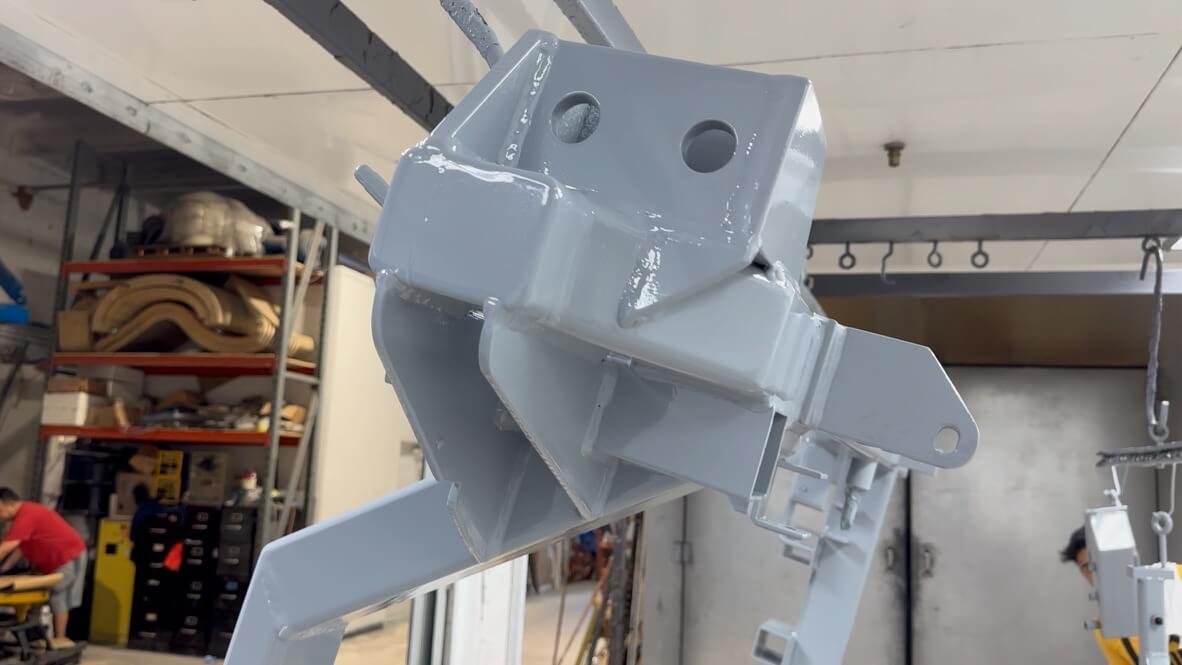
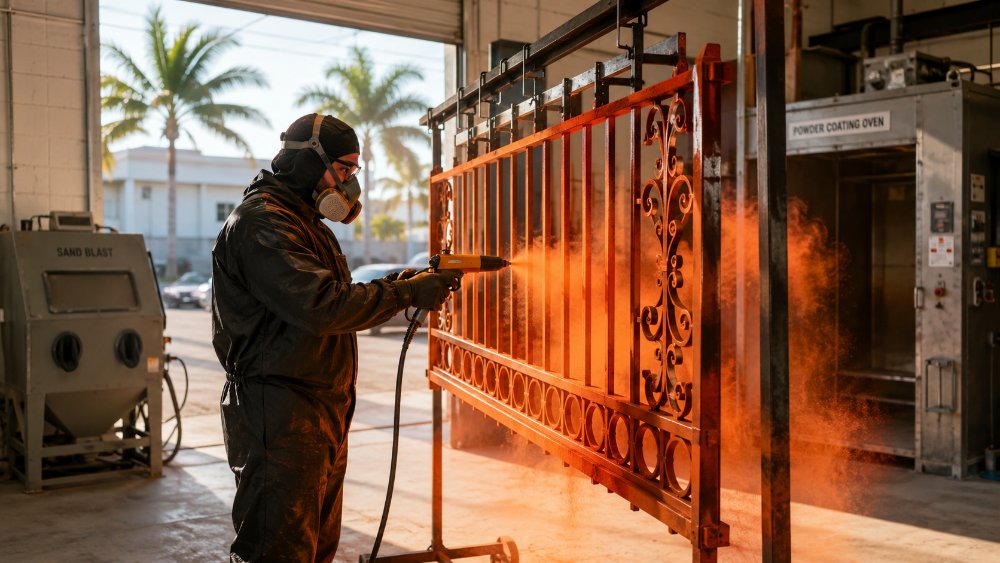
Powder coating is a dry finishing process. A finely ground mixture of resin and pigment is sprayed onto a metal surface with an electrostatic charge, then cured in an oven at around 400°F. The heat melts the powder into a continuous, uniform film that bonds to the metal — not just sits on top of it.
Because there is no liquid solvent, there is nothing to evaporate and no drips, sags, or runs. The result is a thicker, harder, more consistent finish than most paints can achieve in a single application.
What Is Liquid Paint?
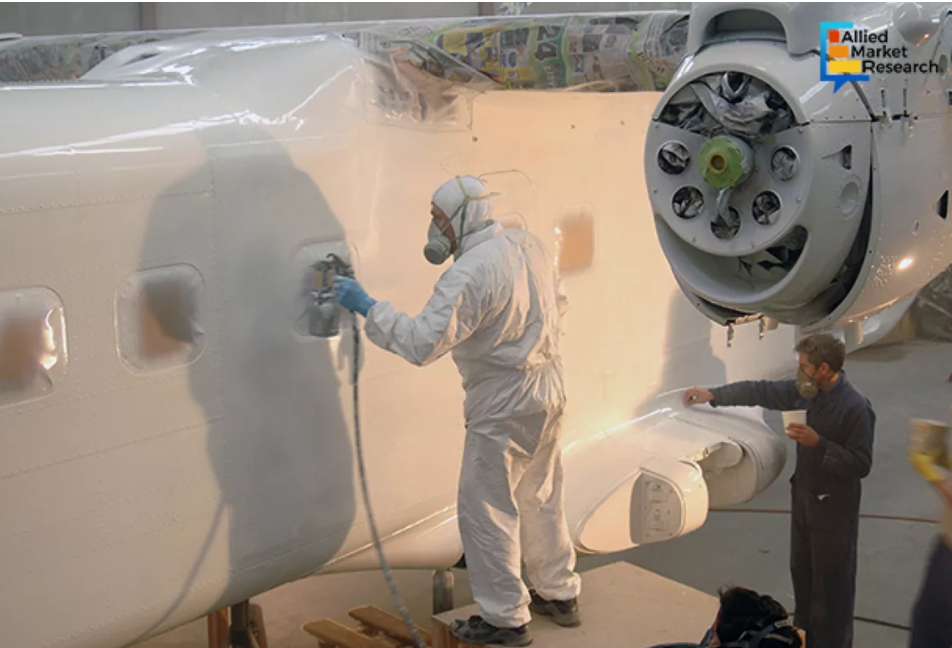
Liquid paint — whether enamel, urethane, or epoxy — is applied with a brush, roller, or spray gun and dries as its solvents evaporate. It has been around for centuries, it is cheap to buy, and it is easy to touch up. For interior walls and indoor equipment, it is perfectly fine.
But liquid paint has a weakness that South Florida exposes brutally: it is thin, and it breathes. Moisture and salts work their way under the film over time, and once that happens, the paint lifts, blisters, and flakes.
The Head-to-Head: What Changes in a Coastal Climate
| Factor | Powder Coating | Liquid Paint |
|---|
|—|—|—|
| Film thickness | 2–6 mils, uniform | 1–3 mils typical |
|---|---|---|
| Corrosion resistance | Excellent — no pinholes for moisture to enter | Good, but thin film fails faster near salt |
| UV / sun resistance | High — resists chalking and fading | Varies; many paints fade quickly |
| Hardness / scratch resistance | Very high — resists chipping | Lower; scratches easily |
| Application consistency | Drips and sags impossible | Runs and sags common |
| Curing | Oven-cured, fully cross-linked | Air-dried; solvents take days to fully cure |
| Touch-ups | Harder to match perfectly | Easy to match |
| Cost over time | Higher upfront, lower maintenance | Lower upfront, repaint sooner |
In Hialeah, a mile from the salt line, that table is not academic. A powder-coated commercial gate can still look sharp ten years in. The same gate with two coats of enamel will usually need attention in three to five.
Why South Florida Is a Different World
Three things make our climate unusually hard on finishes:
- Salt air. Airborne chlorides land on metal and start corrosion the moment they touch it. A thick, pinhole-free film is your only real defense — that is exactly what powder coating delivers.
- Heat and humidity. Air-dried paint cures slowly and unevenly in humid weather, which is precisely when most outdoor projects happen here.
- UV intensity. The same sun that makes the beach beautiful makes pigments fade. High-quality powder formulations are engineered to hold color for years, even in direct Miami sun.
If you have ever repainted the same outdoor furniture or the same trailer three times in a decade, you have already paid for powder coating — you just never got the finish.
Where Powder Coating Earns Its Keep
- Marine equipment and docks: boat trailers, railings, cleats, and hardware that live inches from salt water. (See our marine powder coating services.)
- Outdoor furniture: aluminum and steel frames for restaurants, hotels, and condos that take sun, rain, and pool chemicals daily.
- Industrial and commercial: racks, cages, enclosures, and equipment that take abrasion and chemicals on the plant floor.
- Aerospace and precision parts: where dimensional stability and consistent film thickness matter.
Where Liquid Paint Still Makes Sense
Powder coating is not a magic bullet. Liquid paint is still the right call when:
- You need a perfect color match for a touch-up on an existing painted surface.
- The part is too large for an oven (powder coating requires a curing oven, so anything that cannot fit — or be disassembled — is out).
- The surface will see extreme heat, such as exhaust manifolds, where standard powder would break down.
- You are coating plastic or other low-temperature materials that would melt during curing.
For everything else — especially metal that lives outdoors — powder is the honest recommendation.
The Step People Skip: Surface Preparation
Here is the part that decides whether either finish lasts: preparation. Powder coating is only as good as the surface under it. Oil, rust, old paint, or mill scale will cause adhesion failure no matter how good the powder is.
That is why sandblasting is the first step on most of our jobs. Blasting removes corrosion and contamination down to a clean, slightly roughened profile that gives the powder something to mechanically grip. Skip it to save money, and you will spend more later redoing the job.
The Bottom Line
In South Florida, the math is simple. Powder coating costs more today and less over the life of the part; liquid paint costs less today and more every time you repaint. For gates, railings, furniture, trailers, marine hardware, and industrial equipment that face salt, sun, and humidity — powder coating is the finish that lasts.
Ready to stop repainting? Tell us what you need coated and we will handle the sandblasting, the prep, and a finish built for Miami weather. Call (305) 990-2513 or request a free quote — we serve Hialeah, Miami, and all of South Florida.